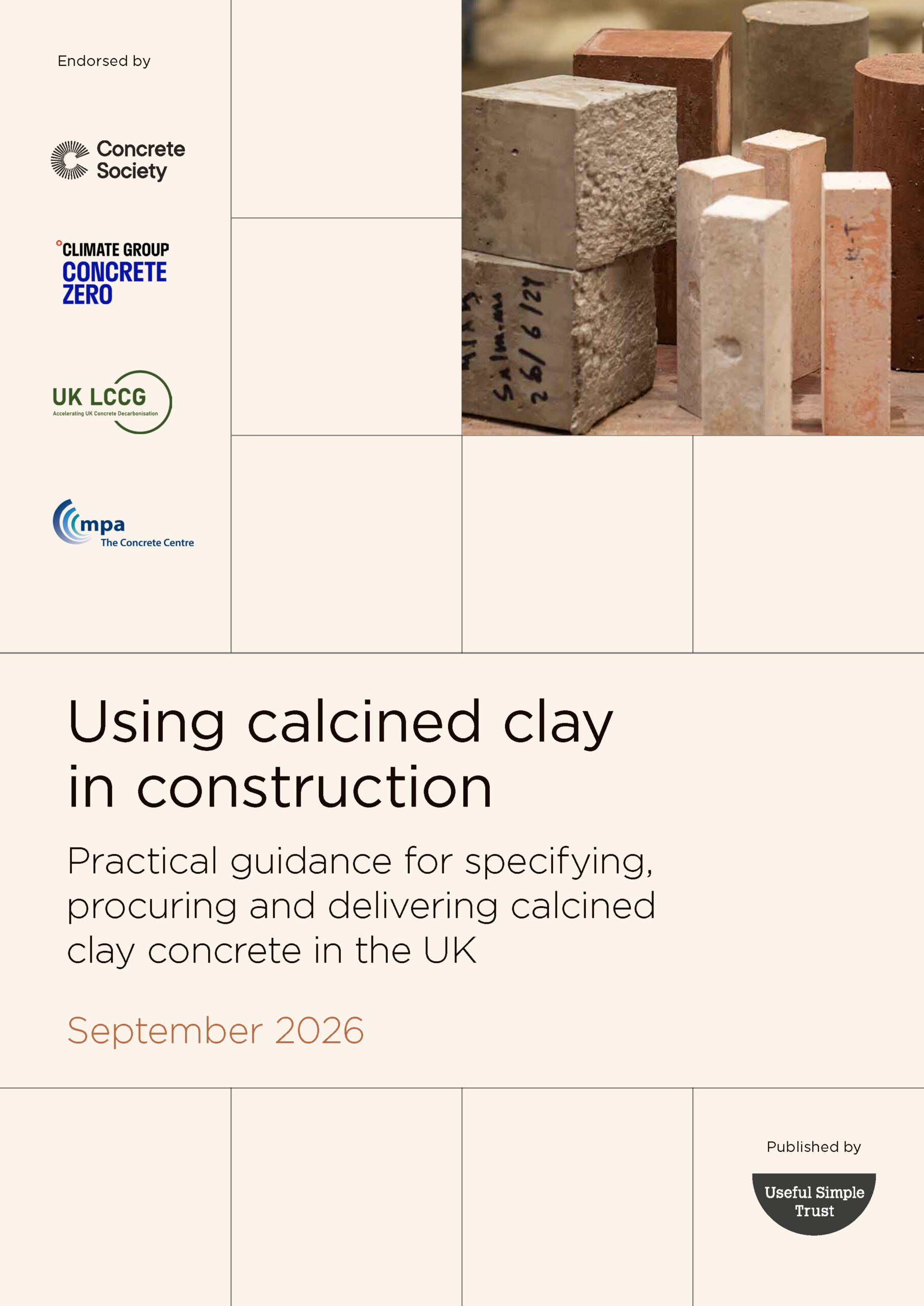
 London, 29 September 2026, The Useful Simple Trust, developed with 19 industry leaders across client, design, contracting, supply, and academic organisations, has today launched Using calcined clay in construction, a practical guide to help clients, designers, contractors, and suppliers use calcined clay as a low-carbon cementitious material in UK projects.
The guidance is endorsed by leading organisations across the UK concrete and construction sector that are helping to drive the transition to lower-carbon materials, including the Concrete Society, ConcreteZero (Climate Group), the UK Low Carbon Concrete Group (UK LCCG), and MPA The Concrete Centre.
Calcined clay has been used for nearly 100 years, including in the foundations of the Golden Gate Bridge. It is compatible with existing UK standards, including BS EN 197 and BS 8500, when correctly specified, supplied and tested – yet it is still not widely used in UK construction. The guidance identifies a supply-demand deadlock as the main barrier: suppliers are reluctant to invest without clear demand, and project teams are reluctant to specify a material whose supply and delivery routes are not yet established.
The guide is designed to break that cycle, enabling calcined clay to be used on projects today. Rather than adding to the technical evidence base, it sets out the practical steps each part of the value chain can take now:
- Where to start: the most accessible entry points for first-time users, including backfill and mass concrete, in-situ permanent works, manufactured products, soil stabilisation and temporary works.
- Who does what: clear roles for clients, designers, main contractors, concrete-placing subcontractors and concrete suppliers, mapped to RIBA stages.
- How to specify: performance-based principles, common clauses that accidentally exclude calcined clay, and example wording from a live UK project.
- How to procure and deliver: early supplier engagement, silo and logistics planning, sources of supply, trial mixes and site familiarisation.
The UK is rich in clay, from naturally occurring deposits to excavated arisings and industrial by-products, giving the industry a real opportunity to build a domestic supply of low-carbon cementitious material. Local supply could mean better resource security, shorter transport distances and less exposure to international price shocks.
Will Arnold, Head of Sustainable Materials at Useful Simple Trust, commented:
“Calcined clay is not a new material, and it already works within UK standards. What’s holding it back isn’t a lack of technical evidence, it’s a lack of coordination: suppliers won’t invest without demand, and project teams won’t specify without supply. This guide is about breaking that cycle, and the first step is talking to your concrete supplier early, before the specification is finalised. Once calcined clay is established at scale in our supply chains, we expect it to become a cost-competitive option.”
Nia Bell, Senior Manager at ConcreteZero Climate Group, reflects:
“This guidance is a strong example of the concrete value chain collaborating to build confidence in the use of calcined clay. As a proven, scalable and cost-effective climate solution, it can help accelerate the delivery of lower-carbon buildings and infrastructure today. By turning technical knowledge into practical action, this document offers a timely model for collaboration in the UK and beyond. We are excited to see the next wave of projects bring calcined clay concrete to scale, helping diversify and decarbonise concrete chemistry across the sector.”
Lessons from real projects
The guide includes six real-world case studies that have used calcined clay concrete in recent years. These prove the material’s use in practice, demonstrating the required strength, workability and finish across a range of applications from precast crash barriers to permanent structural slabs. The write-ups of each case study are also candid about the challenges encountered along the way, including admixture demand, early-age strength, silo availability, import logistics and cost uplift, and how these were overcome through early supply chain engagement, clear performance requirements, and persistence in answering concerns with evidence.
- ACDG (Accelerating Concrete Decarbonisation Group): three full-scale prototypes in Canning Town, with a 12-month testing programme under way.
Broadgate Tower, City of London: a 10 m³ plant deck slab using a C32/40 mix with 30% cement replacement. - EUREKA: an industrial trial with Laing O’Rourke producing precast crash barriers from UK-quarried clay, completed within two months from extraction to manufacture.
- Ex-Clay (HS2 London Tunnels): site-won London Clay was calcined and used in concrete, with mixes containing 35% calcined London Clay and 15% limestone fines. Project-specific mixes can replace up to 55% of Portland cement while meeting a 120-year design life.
- Plot 15, Brent Cross Town: a 35 m³ permanent suspended slab in a residential building, using C50/60 concrete with 30% calcined clay made from damaged UK-sourced brick.
- Double Deck, EPFL (Switzerland): around 6,000 m³ of LC3 concrete, including prestressed elements.
Andrea Charlson, Head of Sustainability UK Concrete & The Concrete Centre, said:
“Interest in calcined clay has grown significantly in recent years, and while technical information is available, guidance that helps practitioners confidently move from understanding new approaches to implementing them on projects is essential. This document provides a practical framework for doing just that, and will be a useful resource for teams exploring options to reduce embodied carbon in construction.”
Pete Winslow, Director at Expedition Engineering and Steering Board Member at UK Low Carbon Concrete Group, commented:
“Rapid scale-up of available, code-compliant, and cost-effective low-carbon supplementary cementitious materials is a critical next step in decarbonising UK concrete. Calcined clay ticks every box and now this guide gives project teams the practical direction they need to specify and use it with confidence, helping to turn established evidence into delivery at scale.”
Using calcined clay in construction is available to download free, here.
-ENDS-